Winnie the Pooh Characters Winnie the Pooh Characters Drawings Baby
| Winnie-the-Pooh | |
|---|---|
 Pooh in an illustration by Due east. H. Shepard | |
| Beginning appearance |
|
| Created by | A. A. Milne E. H. Shepard |
| Based on | Winnie the bear |
| In-universe data | |
| Nickname | Pooh Bear Pooh |
| Species | Comport |
| Gender | Male |
| Home | Hundred Acre Wood |
Winnie-the-Pooh, likewise called Pooh Conduct and Pooh, is a fictional anthropomorphic teddy deport created by English language writer A. A. Milne and English illustrator E. H. Shepard.
The beginning collection of stories nearly the character was the book Winnie-the-Pooh (1926), and this was followed by The Firm at Pooh Corner (1928). Milne likewise included a poem nearly the bear in the children's poesy volume When Nosotros Were Very Immature (1924) and many more than in Now We Are Six (1927). All four volumes were illustrated past E. H. Shepard.
The Pooh stories have been translated into many languages, including Alexander Lenard's Latin translation, Winnie ille Pu , which was commencement published in 1958, and, in 1960, became the only Latin book ever to have been featured on The New York Times Best Seller list.[1]
In 1961, Walt Disney Productions licensed sure film and other rights of Milne's Winnie-the-Pooh stories from the estate of A. A. Milne and the licensing agent Stephen Slesinger, Inc., and adapted the Pooh stories, using the unhyphenated name "Winnie the Pooh", into a serial of features that would eventually become one of its about successful franchises.
In popular film adaptations, Pooh has been voiced by actors Sterling Holloway, Hal Smith, and Jim Cummings in English, and Yevgeny Leonov in Russian.
History
Origin

Original Winnie-the-Pooh stuffed toys. Clockwise from lesser left: Tigger, Kanga, Edward Deport ("Winnie-the-Pooh"), Eeyore, and Piglet. Roo was lost long ago.
A. A. Milne named the grapheme Winnie-the-Pooh afterward a teddy bear endemic by his son, Christopher Robin Milne, on whom the character Christopher Robin was based. The rest of Christopher Milne's toys – Piglet, Eeyore, Kanga, Roo, and Tigger – were incorporated into Milne's stories.[ii] [three] Ii more characters, Owl and Rabbit, were created past Milne'due south imagination, while Gopher was added to the Disney version. Christopher Robin's toy bear is on brandish at the Master Branch of the New York Public Library in New York City.[4]

Christopher Milne had named his toy bear after Winnie, a Canadian black carry he frequently saw at London Zoo, and Pooh, a swan they had encountered while on holiday. The bear cub was purchased from a hunter for C$20 by Canadian Lieutenant Harry Colebourn in White River, Ontario, while en route to England during the Beginning World War.[five] He named the comport Winnie after his adopted hometown in Winnipeg, Manitoba. Winnie was surreptitiously brought to England with her possessor, and gained unofficial recognition equally The Fort Garry Horse regimental mascot. Colebourn left Winnie at the London Zoo while he and his unit were in French republic; after the state of war she was officially donated to the zoo, every bit she had become a much-loved attraction there.[half dozen] Pooh the swan appears as a grapheme in its own right in When Nosotros Were Very Immature.

Statue in Winnipeg of Harry Colebourn and Winnie
In the first affiliate of Winnie-the-Pooh, Milne offers this explanation of why Winnie-the-Pooh is often called but "Pooh":
But his artillery were so stiff ... they stayed upwardly straight in the air for more a week, and whenever a wing came and settled on his nose he had to blow it off. And I recollect – but I am not sure – that that is why he is e'er called Pooh.
American writer William Safire surmised that the Milnes' invention of the name "Winnie the Pooh" may accept also been influenced past the haughty character Pooh-Bah in Gilbert and Sullivan'due south The Mikado (1885).[7]
Ashdown Forest: the setting for the stories
The Winnie-the-Pooh stories are set in Ashdown Forest, East Sussex, England. The woods is an surface area of tranquil open heathland on the highest sandy ridges of the Loftier Weald Area of Outstanding Natural Beauty situated xxx miles (50 km) south-east of London. In 1925 Milne, a Londoner, bought a state home a mile to the north of the forest at Cotchford Subcontract, near Hartfield. According to Christopher Milne, while his father continued to live in London "...the four of usa – he, his wife, his son and his son'south nanny – would pile into a large blue, chauffeur-driven Fiat and travel downward every Sabbatum morn and back once again every Monday afternoon. And we would spend a whole glorious calendar month there in the spring and 2 months in the summertime."[eight] From the front lawn the family had a view beyond a meadow to a line of alders that fringed the River Medway, beyond which the ground rose through more trees until finally "in a higher place them, in the faraway altitude, crowning the view, was a bare hilltop. In the middle of this hilltop was a clump of pines." Near of his male parent'southward visits to the forest at that time were, he noted, family unit expeditions on pes "to brand yet another attempt to count the pine trees on Gill's Lap or to search for the marsh gentian". Christopher added that, inspired past Ashdown Woods, his begetter had made it "the setting for ii of his books, finishing the second little over iii years after his inflow".[9]
Many locations in the stories can exist associated with real places in and around the forest. Equally Christopher Milne wrote in his autobiography: "Pooh's forest and Ashdown Forest are identical." For example, the fictional "Hundred Acre Wood" was in reality V Hundred Acre Wood; Galleon'south Leap was inspired by the prominent hilltop of Gill's Lap, while a clump of copse just due north of Gill'southward Lap became Christopher Robin's The Enchanted Place, considering no-one had ever been able to count whether there were 63 or 64 trees in the circle.[10]
The landscapes depicted in Eastward. H. Shepard'southward illustrations for the Winnie-the-Pooh books were straight inspired by the distinctive landscape of Ashdown Forest, with its high, open heathlands of heather, gorse, bracken and silver birch, punctuated by hilltop clumps of pine trees. Many of Shepard'south illustrations tin be matched to actual views, allowing for a caste of artistic licence. Shepard's sketches of pino trees and other woods scenes are held at the Victoria and Albert Museum in London.[11]
The game of Poohsticks was originally played by Christopher Milne on the wooden footbridge,[12] across the Millbrook,[13] Posingford Woods, close to Cotchford Subcontract. It is now a tourist attraction, and information technology has become traditional to play the game at that place using sticks gathered in the nearby woodland.[12] [14] When the footbridge had to be replaced in 1999, the architect used equally a chief source drawings past Shepard in the books, which differ a little from the original structure.
First publication

Winnie-the-Pooh'due south debut in the 24 Dec 1925 London Evening News
Christopher Robin'south teddy behave made his character début, nether the name Edward, in A. A. Milne's poem, "Teddy Bear", in the edition of 13 February 1924 of Dial (E. H. Shepard had also included a similar bear in a cartoon published in Punch the previous week[15]), and the same poem was published in Milne's book of children'southward verse When Nosotros Were Very Young (6 November 1924).[16] Winnie-the-Pooh first appeared by name on 24 December 1925, in a Christmas story commissioned and published by the London newspaper Evening News. It was illustrated by J. H. Dowd.[17]
The first drove of Pooh stories appeared in the book Winnie-the-Pooh. The Evening News Christmas story reappeared as the first chapter of the book. At the beginning, it explained that Pooh was in fact Christopher Robin's Edward Bear, who had been renamed by the boy. He was renamed after an American blackness comport at London Zoo called Winnie who got her proper noun from the fact that her owner had come from Winnipeg, Canada. The book was published in October 1926 by the publisher of Milne's before children's piece of work, Methuen, in England, Due east. P. Dutton in the Us, and McClelland & Stewart in Canada.[18]
Character
In the Milne books, Pooh is naive and irksome-witted, only he is also friendly, thoughtful, and steadfast. Although he and his friends agree that he is "a bear of very niggling encephalon", Pooh is occasionally best-selling to have a clever thought, usually driven past common sense. These include riding in Christopher Robin'due south umbrella to rescue Piglet from a flood, discovering "the North Pole" by picking it upward to help fish Roo out of the river, inventing the game of Poohsticks, and getting Eeyore out of the river past dropping a big rock on i side of him to wash him towards the bank.
Pooh is also a talented poet and the stories are oft punctuated by his poems and "hums". Although he is humble about his slow-wittedness, he is comfortable with his creative gifts. When Owl's house blows down in a windstorm, trapping Pooh, Piglet and Owl inside, Pooh encourages Piglet (the only one small enough to do so) to escape and rescue them all by promising that "a respectful Pooh song" volition be written nearly Piglet's feat. Later, Pooh muses about the artistic process every bit he composes the vocal.
Pooh is very fond of food, particularly "hunny", just as well condensed milk and other items. When he visits friends, his desire to be offered a snack is in conflict with the impoliteness of asking too directly. Though intent on giving Eeyore a pot of honey for his birthday, Pooh could not resist eating information technology on his style to deliver the present and and so instead gives Eeyore "a useful pot to put things in". When he and Piglet are lost in the wood during Rabbit's endeavour to "unbounce" Tigger, Pooh finds his manner habitation by following the "call" of the honeypots from his house. Pooh makes it a habit to have "a little something" around 11:00 in the morning time. As the clock in his business firm "stopped at five minutes to eleven some weeks ago", any time can be Pooh's snack time.
Pooh is very social. Later Christopher Robin, his closest friend is Piglet, and he well-nigh ofttimes chooses to spend his time with 1 or both of them. But he besides habitually visits the other animals, oftentimes looking for a snack or an audience for his poesy as much as for companionship. His kind-heartedness ways he goes out of his way to be friendly to Eeyore, visiting him and bringing him a birthday present and edifice him a house, despite receiving mostly disdain from Eeyore in render.
Sequels
An authorised sequel Render to the Hundred Acre Wood was published on v October 2009. The author, David Benedictus, has adult, but not changed, Milne'due south characterisations. The illustrations, by Marker Burgess, are in the style of Shepard.[xix]
Some other authorised sequel, Winnie-the-Pooh: The Best Bear in All the World, was published by Egmont in 2016. The sequel consists of four short stories by four leading children'southward authors, Kate Saunders, Brian Sibley, Paul Brilliant, and Jeanne Willis. Illustrations are past Mark Burgess.[twenty] The Best Behave in All The World sees the introduction of a new character, Penguin, which was inspired by a long-lost photograph of Milne and his son Christopher with a toy penguin.[21] A further special story, Winnie-the-Pooh Meets the Queen, was published in 2016 to mark the 90th anniversary of Milne's creation and the 90th birthday of Elizabeth II. It sees Winnie the Pooh run across the Queen at Buckingham Palace.[22]
Stephen Slesinger
On 6 Jan 1930, Stephen Slesinger purchased The states and Canadian merchandising, television set, recording, and other trade rights to the Winnie-the-Pooh works from Milne for a $ane,000 advance and 66% of Slesinger'southward income, creating the modern licensing industry. By November 1931, Pooh was a $50 1000000-a-year business concern.[23] Slesinger marketed Pooh and his friends for more 30 years, creating the get-go Pooh doll, record, board game, puzzle, US radio broadcast (on NBC), animation, and motion picture.[24]
Red shirt Pooh
The first time Pooh and his friends appeared in colour was 1932, when he was fatigued by Slesinger in his now-familiar red shirt and featured on an RCA Victor picture show tape. Parker Brothers introduced A. A. Milne's Winnie-the-Pooh Game in 1933, again with Pooh in his red shirt. In the 1940s, Agnes Brush created the first plush dolls with Pooh in his a shirt. Shepard had drawn Pooh with a shirt every bit early on as the first book Winnie-the-Pooh, which was subsequently coloured cherry-red in later coloured editions.[ citation needed ]
Disney ownership era (1966–present)
After Slesinger's death in 1953, his married woman, Shirley Slesinger Lasswell, connected developing the character herself. In 1961, she licensed rights to Walt Disney Productions in commutation for royalties in the first of 2 agreements between Stephen Slesinger, Inc., and Disney.[25] The same year, A. A. Milne'due south widow, Daphne Milne, too licensed certain rights, including move picture rights, to Disney.
Since 1966, Disney has released numerous animated productions starring its version of Winnie the Pooh and related characters, starting with the theatrical featurette Winnie the Pooh and the Honey Tree. This was followed by Winnie the Pooh and the Blustery Day (1968), and Winnie the Pooh and Tigger Too (1974). These 3 featurettes were combined into a characteristic-length motion picture, The Many Adventures of Winnie the Pooh, in 1977. A fourth featurette, Winnie the Pooh and a Mean solar day for Eeyore, was released in 1983.
A new series of Winnie the Pooh theatrical feature-length films launched in the 2000s, with The Tigger Movie (2000), Piglet's Large Picture show (2003), Pooh's Heffalump Pic (2005), and Winnie the Pooh (2011).
Disney has as well produced television series based on the franchise, including Welcome to Pooh Corner (Disney Channel, 1983–1986), The New Adventures of Winnie the Pooh (ABC, 1988–1991), The Volume of Pooh (Playhouse Disney, 2001–2003), and My Friends Tigger & Pooh (Playhouse Disney, 2007–2010).
Merchandising revenue dispute
Pooh videos, soft toys, and other merchandise generate substantial annual revenues for Disney. The size of Pooh blimp toys ranges from Beanie and miniature to human-sized. In addition to the stylised Disney Pooh, Disney markets Classic Pooh merchandise which more closely resembles Eastward. H. Shepard'south illustrations.
In 1991, Stephen Slesinger, Inc., filed a lawsuit confronting Disney which alleged that Disney had breached their 1983 agreement by again failing to accurately written report revenue from Winnie the Pooh sales. Under this agreement, Disney was to retain approximately 98% of gross worldwide revenues while the remaining 2% was to be paid to Slesinger. In improver, the suit declared that Disney had failed to pay required royalties on all commercial exploitation of the production name.[26] Though the Disney corporation was sanctioned by a judge for destroying twoscore boxes of evidentiary documents,[27] the suit was afterward terminated by some other judge when information technology was discovered that Slesinger'south investigator had rummaged through Disney's garbage to recall the discarded evidence.[28] Slesinger appealed the termination and, on 26 September 2007, a three-estimate panel upheld the lawsuit dismissal.[29]
Later the Copyright Term Extension Act of 1998, Clare Milne, Christopher Robin Milne's daughter, attempted to cease whatsoever time to come Usa copyrights for Stephen Slesinger, Inc.[xxx] Subsequently a series of legal hearings, Gauge Florence-Marie Cooper of the Us District Court in California found in favour of Stephen Slesinger, Inc., as did the U.s. Courtroom of Appeals for the Ninth Circuit. On 26 June 2006, the U.s. Supreme Court refused to hear the case, sustaining the ruling and ensuring the defeat of the adjust.[31]
On nineteen February 2007, Disney lost a courtroom case in Los Angeles which ruled their "misguided claims" to dispute the licensing agreements with Slesinger, Inc., were unjustified,[32] but a federal ruling of 28 September 2009, again from Gauge Florence-Marie Cooper, determined that the Slesinger family had granted all trademarks and copyrights to Disney, although Disney must pay royalties for all futurity employ of the characters. Both parties have expressed satisfaction with the issue.[33] [34]
Other adaptations
Theatre
- 1931. Winnie-the-Pooh at the Guild Theater, Sue Hastings Marionettes[35]
- 1957. Winnie-the-Pooh, a play in three acts, dramatized by Kristin Sergel, Dramatic Publishing Company
- 1964. Winnie-the-Pooh, a musical comedy in 2 acts, lyrics by A. A. Milne and Kristin Sergel, music by Allan Jay Friedman, book past Kristin Sergel, Dramatic Publishing Company
- 1977. A Winnie-the-Pooh Christmas Tail, in which Winnie-the-Pooh and his friends help Eeyore have a very Merry Christmas (or a very happy altogether), with the volume, music, and lyrics by James W. Rogers, Dramatic Publishing Company[36]
- 1986. Bother! The Brain of Pooh, Peter Dennis
- 1992. Winnie-the-Pooh, small bandage musical version, dramatized by le Clanché du Rand, music by Allan Jay Friedman, lyrics by A. A. Milne and Kristin Sergel, additional lyrics by le Clanché du Rand, Dramatic Publishing Company
- 2021. Winnie the Pooh: The New Musical Adaptation.[37]
Sound

RCA Victor tape from 1932 decorated with Stephen Slesinger, Inc.'south Winnie-the-Pooh
Selected Pooh stories read by Maurice Evans released on vinyl LP:
- 1956. Winnie-the-Pooh (consisting of iii tracks: "Introducing Winnie-the-Pooh and Christopher Robin"; "Pooh Goes Visiting and Gets into a Tight Place"; and "Pooh and Piglet Become Hunting and Nearly Take hold of a Woozle")
- More Winnie-the-Pooh (consisting of three tracks: "Eeyore Loses a Tail"; "Piglet Meets a Heffalump"; "Eeyore Has a Birthday")
In 1951, RCA Records released iv stories of Winnie-the-Pooh, narrated by Jimmy Stewart and featuring the voices of Cecil Roy equally Pooh, Madeleine Pierce every bit Piglet, Betty Jane Tyler as Kanga, Merrill Joels every bit Eeyore, Arnold Stang every bit Rabbit, Frank Milano equally Owl, and Sandy Fussell as Christopher Robin.[38]
In 1960, HMV recorded a dramatised version with songs (music by Harold Fraser-Simson) of two episodes from The House at Pooh Corner (Capacity two and 8), starring Ian Carmichael as Pooh, Denise Bryer as Christopher Robin (who as well narrated), Hugh Lloyd as Tigger, Penny Morrell every bit Piglet, and Terry Norris as Eeyore. This was released on a 45 rpm EP.[39]
In the 1970s and 1980s, Carol Channing recorded Winnie the Pooh, The House at Pooh Corner and The Winnie the Pooh Songbook, with music by Don Heckman. These were released on vinyl LP and audio cassette by Caedmon Records.
Entire recordings read by Peter Dennis of the iv Pooh books:
- When We Were Very Young
- Winnie-the-Pooh
- Now We Are Six
- The House at Pooh Corner
In 1979, a double sound cassette set of Winnie the Pooh was produced featuring British actor Lionel Jeffries reading all of the characters in the stories. This was followed in 1981 by an sound cassette set of stories from The Firm at Pooh Corner also read by Lionel Jeffries.[forty]
In the 1990s, the stories were dramatised for audio by David Benedictus, with music composed, directed and played past John Gould. They were performed by a cast that included Stephen Fry as Winnie-the-Pooh, Jane Horrocks as Piglet, Geoffrey Palmer as Eeyore, Judi Dench equally Kanga, Finty Williams as Roo, Robert Daws as Rabbit, Michael Williams as Owl, Steven Webb as Christopher Robin and Sandi Toksvig as Tigger.[41]
Radio
- The BBC has included readings of Winnie-the-Pooh stories in its programmes for children since very soon after their first publication. One of the primeval of such readings, by "Uncle Peter" (C. E. Hodges), was an item in the programme For the Children, broadcast by stations 2LO and 5XX on 23 March 1926. Norman Shelley was the notable voice of Pooh on the BBC's Children's Hour.[42]
- Pooh made his US radio debut on x November 1932, when he was broadcast to 40,000 schools by The American School of the Air, the educational partition of the Columbia Broadcasting Organization.[43]
Pic
2017: Adieu Christopher Robin, a British drama moving-picture show exploring the cosmos of Winnie-the-Pooh with Domhnall Gleeson playing A.A. Milne.
Soviet accommodation
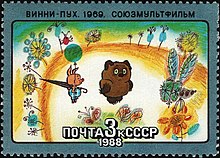
A postage stamp showing Piglet and Winnie-the-Pooh as they appear in the Soviet adaptation
In the Soviet Marriage, three Winnie-the-Pooh, (transcribed in Russian as Винни-Пух , Vinni Pukh ) stories were made into a celebrated trilogy[44] of short films by Soyuzmultfilm (directed by Fyodor Khitruk) from 1969 to 1972, after being granted permission past Disney to brand their ain adaptation in a gesture of Cold State of war détente.[ citation needed ]
- 1969. Winnie-the-Pooh ( Винни-Пух ) – based on affiliate 1
- 1971. Winnie-the-Pooh Pays a Visit ( Винни-Пух идёт в гости ) – based on affiliate 2
- 1972. Winnie-the-Pooh and a Busy Solar day ( Винни-Пух и день забот ) – based on capacity 4 and 6.
The films used Boris Zakhoder's translation of the volume. Pooh was voiced past Yevgeny Leonov. Unlike in the Disney adaptations, the animators did not base their depictions of the characters on Shepard'southward illustrations, instead creating a unlike look. The Soviet adaptations fabricated extensive utilize of Milne's original text and often bring out aspects of Milne'due south characters' personalities not used in the Disney adaptations.
Television set
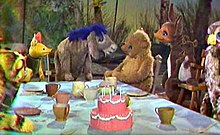
Winnie-the-Pooh and his friends debuted on NBC Television in 1958–1960.
- 1960: Shirley Temple's Storybook on NBC: Winnie-the-Pooh—a version for marionettes, designed, made, and operated by Bil and Cora Baird. Pooh was voiced by time to come Muppet performer Faz Fazakas.
- During the 1970s, the BBC children'south television bear witness Jackanory serialised the ii books, which were read by Willie Rushton.[45]
Cultural legacy

A plaque on Winnie-the-Pooh Street (ulica Kubusia Puchatka) in Warsaw
I of the best known characters in British children'southward literature, a 2011 poll saw Winnie the Pooh voted onto the listing of top 100 "icons of England".[46] Forbes magazine ranked Pooh the most valuable fictional graphic symbol in 2002, with merchandising products alone generating more than than $5.9 billion that year.[47] In 2005, Pooh generated $6 billion, a figure surpassed by only Mickey Mouse.[48] In 2006, Pooh received a star on the Hollywood Walk of Fame, mark the 80th birthday of Milne's creation.[48] The carry is such a popular character in Poland that a Warsaw street is named for him ( Ulica Kubusia Puchatka ). There is also a street named after him in Budapest, Hungary ( Micimackó utca ).[49]
Winnie the Pooh has inspired multiple texts to explain complex philosophical ideas. Benjamin Hoff uses Milne'southward characters in The Tao of Pooh and The Te of Piglet to explain Taoism. Similarly, Frederick Crews wrote essays about the Pooh books in abstract academic jargon in The Pooh Perplex and Postmodern Pooh to satirise a range of philosophical approaches.[50] Pooh and the Philosophers past John T. Williams uses Winnie the Pooh as a properties to illustrate the works of philosophers, including Descartes, Kant, Plato and Nietzsche.[51] "Epic Pooh" is a 1978 essay by Michael Moorcock that compares much fantasy writing to A. A. Milne'southward, as work intended to comfort, not claiming.
In music, Kenny Loggins wrote the song "House at Pooh Corner", which was originally recorded by the Nitty Gritty Dirt Band.[52] Loggins later rewrote the song equally "Return to Pooh Corner", featuring on the anthology of the same proper noun in 1991. In Italy, a popular band took their name from Winnie, and were titled Pooh. In Estonia, there is a punk/metal band called Winny Puhh.
In the "sport" of Poohsticks, competitors drop sticks into a stream from a span and so look to encounter whose stick will cross the end line first. Though it began as a game played past Pooh and his friends in the book The House at Pooh Corner and later in the films, information technology has crossed over into the real world: a World Title Poohsticks race takes place in Oxfordshire each twelvemonth. Ashdown Forest in England where the Pooh stories are fix is a popular tourist attraction, and includes the wooden Pooh Span where Pooh and Piglet invented Poohsticks.[53] The Oxford Academy Winnie the Pooh Society was founded by undergraduates in 1982.
From Dec 2017 to Apr 2018, the Victoria and Albert Museum hosted the exhibition Winnie-the-Pooh: Exploring a Archetype.[54] On exhibit were teddy bears that had not been on display for some 40 years considering they were then frail.[55] [56]
The Japanese figure skater and two-fourth dimension Olympic champion Yuzuru Hanyu regards Pooh as his lucky charm.[57] He is unremarkably seen with a stuffed Winnie-the-Pooh during his figure skating competitions. Considering of this, Hanyu's fans volition throw blimp Winnie-the-Poohs onto the ice afterwards his performance. After one of Hanyu's performances at the 2018 Winter Olympics in Pyeongchang, one spectator remarked that "the water ice turned xanthous" because of all the Poohs thrown onto the ice.[58]
Censorship in China

In the People'due south Republic of China, images of Pooh were censored from social media websites in mid-2017, when Internet memes comparison Chinese Paramount Leader and General Secretary of the Communist Political party 11 Jinping to (Disney's version of) Pooh became popular.[59] The 2018 flick Christopher Robin was also denied a Chinese release.[60]
When Xi visited the Philippines, protestors posted images of Pooh on social media.[61] Other politicians have been compared to Winnie-the-Pooh characters alongside Xi, including Barack Obama every bit Tigger, Carrie Lam, Rodrigo Duterte,[62] and Peng Liyuan as Piglet,[63] and Fernando Chui and Shinzo Abe as Eeyore.[64]
Pooh's Chinese name (Chinese: 小熊维尼; lit. 'little behave Winnie') has been censored from video games such equally Globe of Warcraft, PlayerUnknown'south Battlegrounds, Arena of Valor,[65] and Devotion.[66] Images of Pooh in Kingdom Hearts Iii were besides blurred out on the gaming site A9VG.[67]
Despite the ban, two Pooh-themed rides withal operate in Disneyland Shanghai, and it is as well legal to buy Pooh-deport merchandise and books about Winnie the Pooh in Communist china.[68] [69]
In October 2019, Pooh was featured in the South Park episode "Band in Prc" because of his alleged resemblance with Xi. In the episode, Pooh is brutally killed by Randy Marsh. South Park was banned in Communist china every bit a result of the episode.[70]
References
- ^ McDowell, Edwin. "Winnie ille Pu Nigh XXV Years Afterwards", The New York Times (xviii November 1984). Retrieved 2 January 2010.
- ^ "Pooh celebrates his 80th altogether". BBC News. Retrieved 20 July 2015
- ^ Ford, Rebecca (28 February 2007) "Happy Birthday Pooh" [ permanent dead link ] , Daily Limited. Retrieved twenty July 2015
- ^ "The Adventures of the Real Winnie-the-Pooh. The New York Public Library.
- ^ "Winnie the Pooh's Canadian beginnings". The Hamilton Spectator. Hamilton, Ontario. two August 1997. p. W.13 – via PQArchiver.com.
- ^ "Winnie". Historica Minutes, The Historica Foundation of Canada. Retrieved 30 May 2008.
- ^ Safire, William. 1993. "Whence Poo-Bah". GASBAG 24(3) issue 186:28–28.
- ^ Willard, Barbara (1989). The Forest – Ashdown in East Sussex. Sussex: Sweethaws Press. . Quoted from the Introduction, p. xi, past Christopher Milne.
- ^ Willard (1989). Quoted from the Introduction, p. eleven, by Christopher Milne.
- ^ Hope, Yvonne Jefferey (2000). "Winnie-the-Pooh in Ashdown Wood". In Brooks, Victoria (ed.). Literary Trips: Following in the Footsteps of Fame. Vol. 1. Vancouver, Canada: Greatest Escapes. p. 287. ISBN0-9686137-0-5.
- ^ "About the E. H. Shepard archive". Surrey.ac.uk. University of Surrey. Retrieved 1 May 2012.
- ^ a b "Plans to improve access to Pooh Span unveiled". BBC News. Retrieved xi November 2012
- ^ Named stream Open Street Map. Retrieved 2019-11-23
- ^ "Appeal to save Winnie the Pooh's bridge". BBC News. Retrieved 11 November 2012
- ^ Davies, Ross Eastward. "An Ursine Foot Note", Re-readings, vol. 5, 2020, p. 2.
- ^ "Celebrate Winnie-The-Pooh's 90th with a Rare Recording (and Hunny)". NPR.org. National Public Radio. twenty July 2015.
- ^ "A Children'south Story by A. A. Milne". Evening News. London. 24 December 1925. p. one.
- ^ Thwaite, Ann (2004). Oxford Dictionary of National Biography: Alan Alexander Milne. Oxford University Press.
- ^ Kennedy, Maev (4 Oct 2009). "Pooh sequel returns Christopher Robin to Hundred Acre Wood". The Guardian. p. 15.
- ^ "Winnie-the-Pooh sequel details revealed". Retrieved 18 October 2016.
- ^ "Heed to the moment Winnie-the-Pooh meets penguin friend in new book". BBC News. nineteen September 2016.
- ^ "Winnie the Pooh meets the Queen in a new story". BBC News. 19 September 2016.
- ^ "The Merchant of Child". Fortune. Nov 1931. p. 71.
- ^ McElway, St. Claire (26 Oct 1936). "The Literary Grapheme in Business organisation & Commerce". The New Yorker.
- ^ Leonard, Devin (twenty January 2003). "The Curse of Pooh". Fortune . Retrieved 29 April 2018.
- ^ Shea, Joe (18 Jan 2002). "The Pooh Files". The Albion Monitor. Archived from the original on 5 December 2006.
- ^ Nelson, Valerie J. (20 July 2007). "Shirley Slesinger Lasswell, 84; fought Disney over Pooh royalties". Los Angeles Times . Retrieved xviii January 2019.
- ^ James, Meg (xviii Jan 2002). "Courtroom Rulings Go Confronting Disney in Pooh Dispute". Los Angeles Times . Retrieved 21 October 2021.
- ^ James, Million (26 September 2007). "Disney wins lawsuit ruling on Pooh rights". Los Angeles Times . Retrieved 26 September 2007.
- ^ "Winnie the Pooh goes to court". USA Today. six November 2002. Retrieved eighteen Jan 2019.
- ^ "Justices won't hear copyright appeal by relative of Winnie the Pooh". USA Today. Associated Press. 26 June 2006. Retrieved xviii January 2019.
- ^ "Disney loses court battle in Winnie the Pooh copyright example". ABC News. 17 February 2007. Retrieved 15 May 2008.
- ^ James, Million (29 September 2009). "Pooh rights vest to Disney, guess rules". Los Angeles Times . Retrieved 5 October 2009.
- ^ Shea, Joe (4 October 2009). "The gordian knot of Pooh rights is finally untied in federal court". The American Reporter . Retrieved 5 October 2009. [ dead link ]
- ^ "Hastings Marionettes: Will Open Holiday Season at Guild Theatre on Saturday". The New York Times. 22 December 1931. p. 28.
- ^ Quamme, Margaret. vii December 2019. "'A Winnie-the-Pooh Christmas Tail:' Delightful production a low-fundamental, agreeable 60 minutes of fun" (review). The Columbus Dispatch.
- ^ Rabinowitz, Chloe. "WINNIE THE POOH: THE NEW MUSICAL Accommodation Will Open up Off-Broadway This Fall". BroadwayWorld.com.
- ^ "Disney's "Winnie the Pooh" on Records". cartoonresearch.com . Retrieved 23 February 2021.
- ^ "Ian Carmichael and Full Bandage – The House at Pooh Corner – HMV Junior Tape Club – United kingdom – 7EG 117". 45Cat.com. 23 July 2010. Retrieved 5 November 2011.
- ^ Winnie the Pooh. OCLC 220534420.
- ^ Tigger Comes to the Woods: And Other Stories. OCLC 141191344.
- ^ Ian Hartley, Goodnight children...everywhere Midas Books: Hippocrene Books, New York: 1983; p. 42
- ^ "His Master's Voice Speaks Again". Playthings. November 1932.
- ^ "Russian animation in messages and figures: 'Winnie the Pooh'". Animator.ru. Retrieved 9 March 2015.
- ^ Biography: Willie Rushton. BBC. Retrieved xi March 2015.
- ^ "Icons of England: The 100 Icons as voted by the public". Civilisation 24 News. 20 July 2015.
- ^ "Pinnacle-earning Fictional Characters". Forbes (New York). 25 September 2003. Retrieved 11 Nov 2012.
- ^ a b "Pooh joins Hollywood Walk of Fame", BBC News. Retrieved 24 Nov 2014
- ^ "@47.415006,xix.138366,17z". Google Maps. 1 Jan 1970. Retrieved 9 March 2015.
- ^ spiked-culture |Article |Pooh-poohing postmodernism Archived 16 June 2007 at the Wayback Automobile. Spiked-online.com. Retrieved 12 Feb 2011.
- ^ Sonderbooks Book Review of Pooh and the Philosophers. Sonderbooks.com (twenty April 2004). Retrieved 12 February 2011.
- ^ "House at Pooh Corner by Loggins and Messina Songfacts". Songfacts.com. 14 October 1926. Retrieved nine March 2015.
- ^ Plans to better access to Pooh Bridge unveiled. BBC. Retrieved 15 October 2011
- ^ "Winnie-the-Pooh: Exploring a Classic". VAM.ac.uk. Victoria and Albert Museum. Retrieved 5 April 2020.
- ^ Kennedy, Maev (3 September 2017). "Winnie-the-Pooh heads to V&A for big winter exhibition". The Guardian. ISSN 0261-3077. Retrieved 4 April 2020.
- ^ Kennedy, Maev (four December 2017). "Winnie-the-Pooh heads to the V&A in London for deport-all exhibition". The Guardian. ISSN 0261-3077. Retrieved five April 2020.
- ^ [160320] Yuzuru Hanyu interview from CBC Sports, archived from the original on 29 October 2021, retrieved 21 March 2021
- ^ Longman, Jeré (4 Jan 2018). "The Greatest Figure Skater Ever Is Michael Jackson on Ice, Surrounded by Winnie the Poohs". The New York Times. ISSN 0362-4331. Retrieved 21 March 2021.
- ^ McDonell, Stephen (17 July 2017). "Why China censors banned Winnie the Pooh". BBC News. Archived from the original on eight January 2019. Retrieved 6 October 2017.
- ^ "Mainland china denies entry to Disney'southward Winnie the Pooh film: source". Reuters. Thomson Reuters. seven August 2018. Archived from the original on 7 August 2018.
- ^ "Lots of Winnie the Pooh on your newsfeeds? It's Filipino netizens' burn down against Chinese leader Xi". CNN.com . Retrieved 22 March 2019.
- ^ "Filipinos troll Xi Jinping, Duterte alee of Chinese President's Manila arrival - Coconuts". coconuts.co . Retrieved ten December 2021.
{{cite web}}: CS1 maint: url-condition (link) - ^ Cheng, Kris (23 October 2018). "Satirist compares Xi Jinping and Hong Kong leader Carrie Lam to Winnie the Pooh and Piglet". Hong Kong Free Press . Retrieved five September 2020.
- ^ Linder, Alex (24 October 2018). "Netizens cast Hong Kong leader Carrie Lam equally the Piglet to Xi Jinping's Winnie the Pooh". Shanghaiist . Retrieved 22 March 2019.
- ^ Trent, John F. (20 March 2019). "Report: 'Winnie the Pooh' Censored in Globe of Warcraft, PUBG, and Arena of Valor in China". Bounding Into Comics . Retrieved 22 March 2019.
- ^ Horti, Samuel (23 February 2019). "Devotion review bombed by Chinese Steam users over Winnie the Pooh meme". PC Gamer . Retrieved 22 March 2019.
- ^ Ashcraft, Brian (23 November 2018). "Chinese Game Site Censors Winnie the Pooh in Kingdom Hearts III". Kotaku . Retrieved 29 May 2019.
- ^ Stolworthy, Jacob; "Winnie the Pooh could exist banned from Shanghai Disneyland as a result of an ongoing meme used to criticize People's republic of china'southward leader", The Independent, xx November 2018, via Business organisation Insider.
- ^ "How Banned Is Winnie the Pooh in Communist china, Actually?". MEL Magazine. 23 September 2020. Retrieved ii December 2021.
- ^ Parker, Ryan; Brzeski, Patrick (7 October 2019). "'South Park' Scrubbed From Chinese Internet After Critical Episode". The Hollywood Reporter.
External links
-
 Winnie-the-Pooh public domain audiobook at LibriVox
- Winnie-the-Pooh at Curlie
- The original bear, with A. A. and Christopher Robin Milne, at the National Portrait Gallery, London
- The real locations, from the Ashdown Forest Conservators
- Winnie-the-Pooh at the New York Public Library
- "Winnie the Pooh saga turns 100 years erstwhile", CBC News, 24 August 2014.
- "The skull of the 'real' Winnie goes on brandish", BBC News, 20 November 2015.
dickersonharl1989.blogspot.com
Source: https://en.wikipedia.org/wiki/Winnie-the-Pooh
0 Response to "Winnie the Pooh Characters Winnie the Pooh Characters Drawings Baby"
Post a Comment