Grease Multipurpose Crc Silaramic Brake System Grease Reviews and Ratings
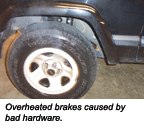 E'er hear the saying, "The squeaky wheel gets the grease?" The saying really refers to persistence and never giving upward — not greasing the brakes.
Click Here to Read More
Staying power is what special-purpose brake lubricants are supposed to have when the going gets hot. The front brakes on many FWD cars, as well as big SUVs, tin can become extremely hot when braking hard or braking repeatedly. Mountain driving, aggressive driving in terminate-and-become traffic or off-road, towing a trailer, hauling a heavier than normal load, etc., can all increase the operating temperature of the brake system.
Under extreme driving conditions, some lubricants tin can't stand the rut and melt off, evaporate, oxidize or burn. That's why ordinary, general-purpose chassis grease should never exist used for lubricating brake components. Information technology won't hold up. What's needed is a peculiarly formulated, loftier-temperature brake grease that tin can withstand the heat, and too not harm rubber seals or plastic bushings. Petroleum-based lubricants should never exist used for restriction assembly work because mineral oils can cause seals to bang-up and neglect.
What needs to be lubricated? Mechanical components in the brake arrangement that slide, motility, rotate or conduct pressure. Why practice lubricants work to reduce some brake noises? It is a simple answer. When a caliper finger is lubricated at the point it touches the brake pad, the lubricant creates a purlieus layer that separates the vibration of the restriction pad from exciting the caliper finger and the caliper. This is one approach to solving NVH bug that tin have its limitations. Lubricants do not dampen forces by calculation actress mass like a brake shim. Likewise, lubricants cannot fill up in pitting on brake slides. Additionally, lubricants do not insulate against vibration and is effective for some frequencies.
The primary lubrication points in a drum brake include the raised pads on the backing plate that support the shoes, the star adjuster machinery, swivel points for self-adjusters or the parking brake linkage, and the parking brake cables.
In disc brakes, lubrication points include the caliper slides and bushings, self-adjuster mechanisms on rear disc brakes with locking calipers, and the parking brake cables and linkage. Restriction grease can also exist used to dampen vibrations between disc brake pads and caliper pistons. But, information technology should not be practical between the pad and whatever noise suppression shims that may be used. Use it on the back of a bare pad or between the pad shim and caliper.
One place you never, e'er want to get whatsoever grease on is the friction surface of a restriction lining — which is another reason for not using low-temperature or petroleum-based lubricants which can melt, run off and foul the linings. Grease-contaminated shoes or pads volition be grabby and usually cause a brake pull to one side. The only cure is to supervene upon the fouled linings with new ones. Cleaning is out of the question because solvents and cleaners tin can adversely affect the linings, besides.
When it comes to brake lubricants, grease is a dirty word. Brake lubricants are specially-formulated products that are not the same as ordinary chassis grease or even multi-purpose grease.
The kind of grease that'southward used to lube tie rod ends, ball joints and U-joints is not the same equally the lubricants that are required for brake system components. In fact, ordinary grease may cause serious problems if it is used on brake hardware or hydraulic components.
As every technician should know, many petroleum-based products are not uniform with the seal materials that are commonly used within brake systems. Petroleum-based grease or oil should never come into contact with the rubber seals, pistons or other internal parts in a main cylinder, brake caliper or wheel cylinder. If it does, the entire restriction organisation should exist considered contaminated. This will crave draining and flushing the entire arrangement, and replacing all the major hydraulic components! Why? Because petroleum-based products can cause incompatible seal materials to swell, rupture and leak – which could pb to fluid loss and restriction failure.
Brake lubricants, by comparison, are specially formulated products that are designed exclusively for brake applications and naught else. The chemicals in these products are compatible with all commonly used seal materials, and will not harm these parts.
Several Basic Types
There are several basic types of restriction lubricants: those that are designed for lubricating hardware and mechanical components and typically contain a high percent of solids (dry moving-picture show lubricants), and those that are designed for lubricating seals, boots and other internal parts when assembling calipers, wheel cylinders and master cylinders.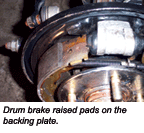
Brake lubricant for hardware is a special high temperature grease designed to provide long-lasting protection. The lubricant may be a synthetic or silicone-based production. Synthetic-based, boundary-type lubricants that come up in a tube, paste or stick form have a high solids content and typically contain a variety of friction-reducing ingredients such as molybdenum disulfide (moly or MOS2) and graphite.
Moly and graphite are both dry-film lubricants that can handle high temperatures and pressures. Some of these products are rated to withstand intermittent temperatures as high equally 2,400 degrees F!
Moly and graphite have excellent staying power and won't evaporate or fire off over time, and they won't attract or hold dirt like ordinary "wet" greases tin can. This type of product is ideal for loftier temperature applications where long-lasting metal-to-metal lubrication is essential for proficient brake operation.
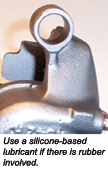
Silicone-based brake grease is designed for caliper and bicycle cylinder assembly work because silicone is an excellent lubricant for rubber and plastic. It is uniform with all rubber compounds including nitrile, teflon, nylon and other synthetic rubbers. Silcone'southward normal working range is -twoscore degrees F to 400 degrees F. But it does not accept the loftier temperature staying power of a loftier solids constructed lubricant, and it is a "wet" lubricant that tin attract and hold dirt, making it less suited for lubricating external metal-to-metal contact points, such as caliper mounts and shoe pads. This blazon of product is best suited for assembling calipers, wheel cylinders and master cylinders.
Another synthetic-based restriction lubricant uses polyalphaolefin (PAO) equally its main ingredient. PAO-based brake lubricants are also excellent for assembly work and lubricating seals and boots. PAO offers superior rust protection, making it well-suited for brake systems operated in wet environments.
PAO brake lubricant may also include diverse amounts of moly, graphite and teflon to heighten its lubricating properties. This blazon of production can withstand intermittent temperatures of up to 600 degrees F, and can be used for both assembly and external lubrication.
White lithium is a low-temperature grease that can be used to lubricate pulsate brake hardware and backing plates, but lacks the heat-resistance for front disc brake applications. So this type of grease is not the best choice for general brake work. Regardless of what type of brake lubricant y'all choose, e'er follow the supplier's recommendations equally to how their product should be used.
Where to Use It
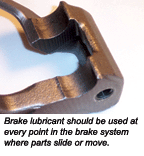
Brake lubricant should be used at every point in the brake system where parts slide or movement. With disc brakes, lubrication points include the caliper slides, pins and bushings, the contact points where the pads slide within the caliper housing, self-adjuster mechanisms on rear disc brakes with locking calipers, and the parking brake cables and linkage.
Brake lubricant tin also exist used to dampen vibrations betwixt disc restriction pads and caliper pistons. But it should not be practical between the pads and any dissonance suppression shims that may be used. Utilise information technology on the dorsum of a bare pad or betwixt the pad shim and caliper – and use it sparingly. Don't glob it on.
The primary lubrication points in rear pulsate brakes include the raised pads on the backing plates that support the shoes, the star adjuster mechanisms, hinge points for self-adjusters or the parking restriction linkage, and the parking brake cables.
One place y'all never, ever desire to get any grease on is the friction surface of a brake lining – which is another reason for non using low-temperature or petroleum-based lubricants which can melt, run off and foul the linings. Grease contaminated shoes or pads will be grabby and usually cause a restriction pull to one side. The but cure is to supercede the fouled linings with new ones. Cleaning is out of the question because solvents and cleaners tin adversely bear upon the linings, also.
For lubricating hydraulic components, such equally the piston seals inside calipers and wheel cylinders, you tin use a silicone-based restriction lubricant or ordinary brake fluid. This type of lubricant will assistance assure shine move of the seals in their bores, and will help prevent these parts from sticking or corroding.
There are iii criteria to remember when selecting a brake lubricant. First, does it say that its a brake lubricant on the package? If non, practise not apply. Some lubricates may say they are a silicone or molybdenum disulfide based, but they may not be formulated to piece of work at on brakes. Second, look at the effective temperature range or the lubricant. At minimum, a lubricant should exist able to handle 400 degrees Fahrenheit. Third, check to see if it contains petroleum distillates or any substance that can exist detrimental to soft parts.
dickersonharl1989.blogspot.com
Source: https://www.tirereview.com/brake-lubricants-101/
0 Response to "Grease Multipurpose Crc Silaramic Brake System Grease Reviews and Ratings"
Post a Comment