When Did the Nazi Party Gain Control of Germany Again
Hitler's rise to power, 1919-1933
Hitler joined the Nazi Party in 1919 and was influential in defining its beliefs. He likewise led the Munich Coup d'état in 1923. However, from 1924 to 1929 the unpopular party gained little electoral success.
The Nazi Party rebuilds, 1924-1929
Hitler was released from jail after the Munich Putsch in Dec 1924. He committed the Nazis to democratic politics – taking part in elections – and began to reorganise the party, strengthening his dominance as leader and start to build a national party structure. Even so, the period up to 1929 is known as the Nazi Political party's 'lean years' considering ii obviously contradictory things were happening to it:
- information technology was growing in size – its membership increased from 27,000 in 1925 to 130,000 in 1929
- simply it struggled to win seats in the Reichstag :
| Ballot | May 1924 | December 1924 | May 1928 |
|---|---|---|---|
| Number of seats won by the Nazis | 32 | 14 | 12 |
| Total number of seats in the Reichstag | 472 | 493 | 491 |
Development of the Nazi Party
Party reorganisation
The determination to pursue power through autonomous methods meant the party needed a national structure to attract members, develop polices and campaign. Hitler put this in place during 1925 and 1926.
New structure of the Nazi Party:
Propaganda
Mein Kampf
While in jail Hitler wrote a volume called Mein Kampf ( My Struggle ), which was an autobiography-cum-manifesto, laying out his political beliefs and ambitions. Many of the ideas contained in the books directly informed Nazi policy after 1933 under the 3rd Reich, including:
- The conventionalities that the Jews were an inferior race to the German Aryans , and also represented a threat to the German state.
- The need to destroy the parliamentary system of government and supplant information technology with that of a single, strong dictator.
- Deutschland'southward requirement for Lebensraum, or living space, to house its growing population. This required Germany to expand to the East into Poland and Russia.
Developing techniques
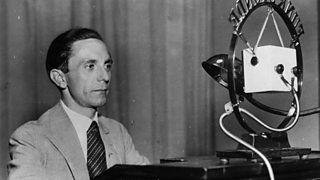
Josef Goebbels – the Berlin Gauleiter at this fourth dimension – was clever because he experimented with new techniques and methods to share the Nazis' message. Posters started to prove Hitler as a strong leader, speeches were arranged in public places and rallies were held to capture people's enthusiasm.
The Bamberg Briefing, 1926
Hitler called a special Nazi Party conference on fourteen February 1926 at Bamberg in southern Germany in response to tension betwixt the northern and southern sections of the party. During his time in jail disagreements had grown between the two sections:
- the northern section, led by a man named Gregor Strasser, was keen to emphasise the socialist elements of the 25-Bespeak Programme to attract back up from the workers
- the southern section more than interested in the nationalist and racist policies in order to attract back up from the middle classes and farmers
The results of the briefing were:
- Hitler insisted that policies which could be painted as communist , such as taking land from rich noblemen, would not be pursued.
- Yet, the conference did reaffirm the 25-Signal Program, with its socialist ideas, as the political party's policy platform.
- In add-on, Hitler established the Fuhrerprinzip, or 'Leader Principle', the idea that the party's leader was in absolute control and all members must follow his directions. No dissent from this was expected or tolerated.
Reasons for limited support for the Nazi Party, 1924–1928
Despite all of this development of the party, by 1928 the Nazis were still on the fringes of politics in Weimar Germany for several reasons:
- Gustav Stresemann'south economic policies had helped Deutschland a lot. Afterwards 1923, the introduction of a new currency and the Dawes Programme had helped to plow Weimar'due south economy around and Germans began to feel more prosperous .
- As a result of this, Federal republic of germany was also more politically stable. Germans voted for moderate parties who supported the Republic, rather than more farthermost parties like the Nazis who wanted to abolish information technology.
- At a time of stability, scaremongering and playing on people's fears was less likely to work. The Nazis' messages about the dangers posed past Jews and the need to abolish democracy largely fell on deafened ears.
- Hitler was jailed and and then banned from speaking in public until 1927 later the Munich Putsch . This prevented the political party from campaigning finer.
- The Nazi Political party was nether constant force per unit area from the Weimar regime following the Munich Putsch. Several times information technology was banned nationally or in sure parts of Deutschland.
Nevertheless, the party was developing effective propaganda techniques under its Berlin Gauleiter, Joseph Goebbels, which would enable it to capitalise on the economical disaster that was to strike Germany from 1929 onwards.
dickersonharl1989.blogspot.com
Source: https://www.bbc.co.uk/bitesize/guides/z3bp82p/revision/4
0 Response to "When Did the Nazi Party Gain Control of Germany Again"
Post a Comment